Floating Leaves Tea Home ---Shiuwen's Blog!

Monday, October 07, 2013

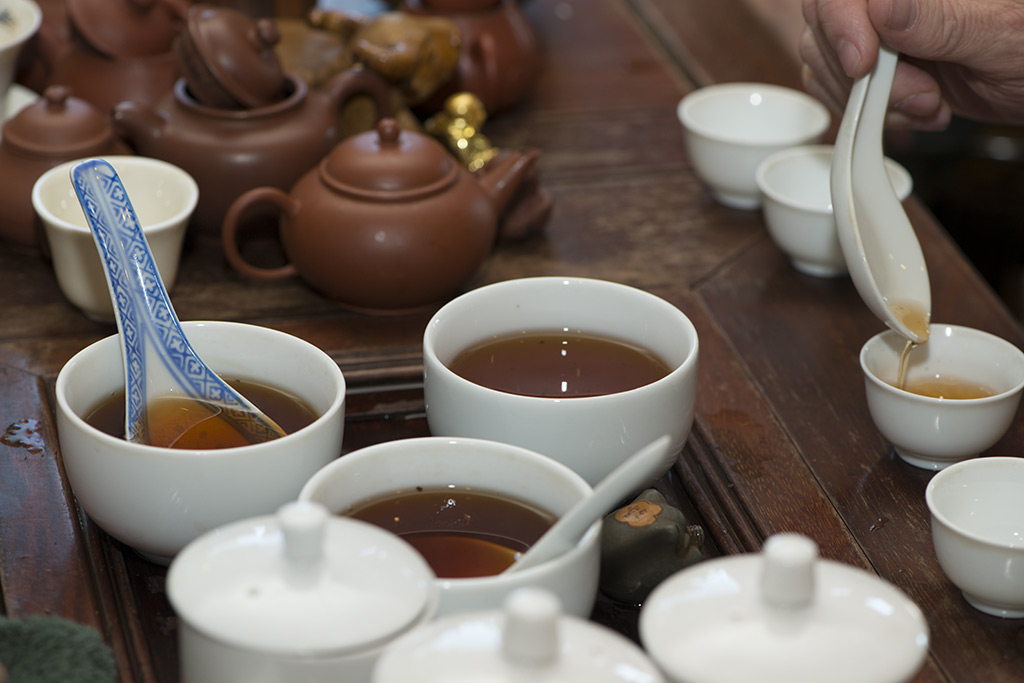
Comparing Menghai Factory Puer #7542


In our previous tea club meeting, we tasted seven 7542 puer cakes. As usual, we had a great time drinking tea together. Here are some tasting notes:

We started with a 2011 #7542 puer cake. Overall, the tea is a good daily drinker. The tea broth has a medium amount of body.

Then we proceeded to brew two 2008 cakes side by side. One of the 2008 cakes is from a drier environment. Both teas still taste green and young. At this stage, we prefer the cake from the drier storage, because the tea has more aftertaste. Between 2011 to 2008, we noticed the liquid of the 20098 teas are a bit thicker.


We finalized our tasting with 4 different years of 7542: a 2003, 1997, 1991, and a 1988. The 1991 cake has clearly been in wet storage. Both of the 1991 and 1988 tea broths have changed into that beautiful, dark amber color, and have a much richer mouthfeel, too. Amazingly, we all like the wet storage cake the best. The bad "wet storage" taste is not in the broth at all and it turned out to be the richest and roundest tea among these 4 teas.


Our impression of the 7542 cake recipe is that it's a good tea to have on a daily basis. If one stores the cake long enough, it will turn into a nice warm, sweet, and thick cup of tea.

*photos provided by Jason Gift.


Saturday, September 21, 2013

Water Temperature For Oolong

I am often asked about the temperature of the water I use for my teas. My answer is pretty much always "boiling." I want to clarify that the teas I drink the most are Taiwanese Oolong and Puer. This post will mainly be about Taiwanese Oolong.


When I am in Taiwan, I watch and ask tea farmers and tea people what temperature they use for their Oolong teas. So far, no matter where I am in Taiwan, I always see them use boiling water for tea. I also notice that they don't boil their water for every infusion. I have asked them why, and they have said that after one boils up the same pot of hot water for the third time, the water is considered "dead." So here is generally what I see in Taiwan:  farmers and tea people boil their water for the first infusion, and then by the 3rd or 4th infusion, they will boil the same pot of water again, for the 2nd time.

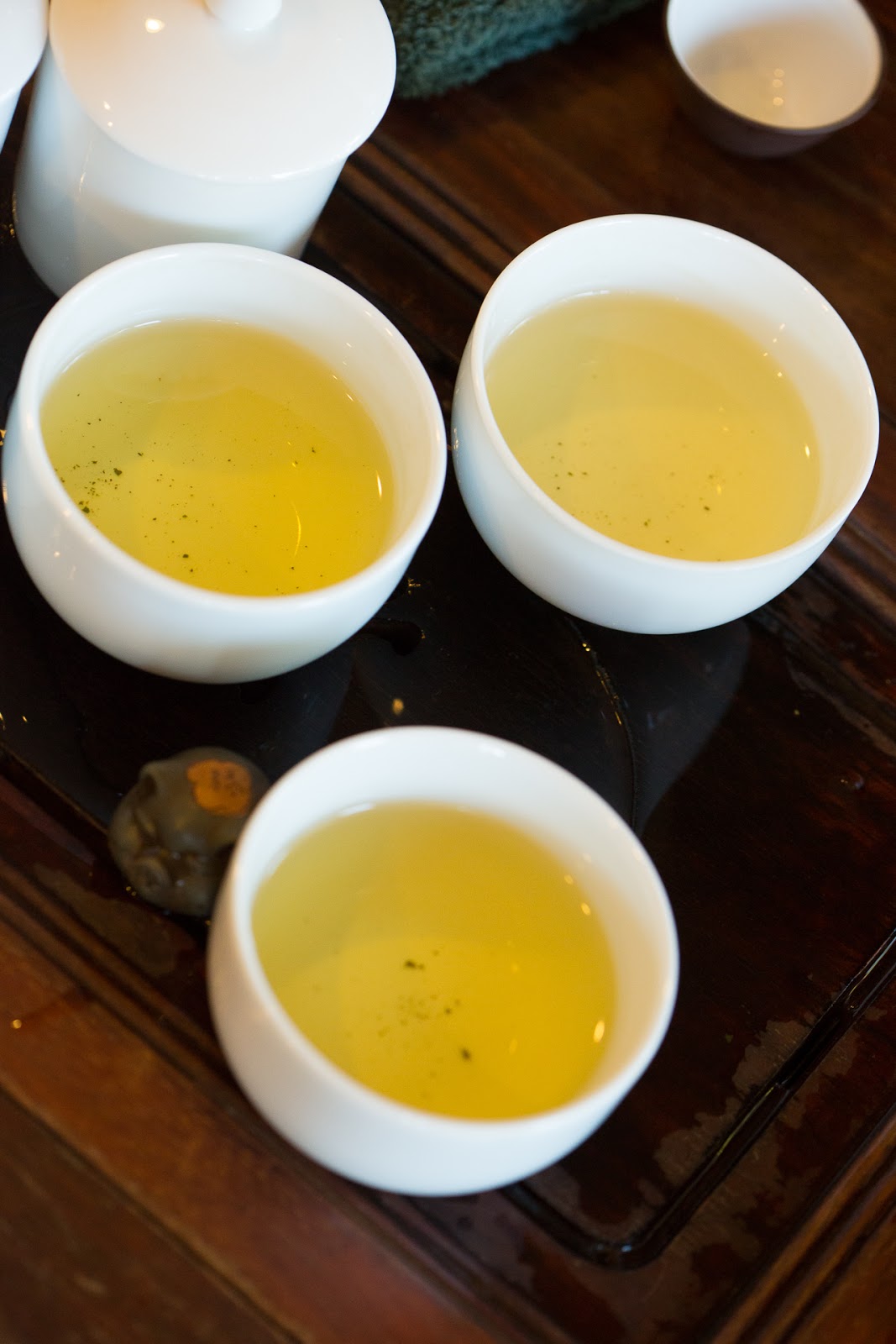
I thought it would be fun to experiment with water temperature. I had two tea friends over to taste teas with me. We brewed our Baozhong Competition Style with 190 degree, 200 degree and boiling water. We all prefer the Baozhong brewed with boiling water. It had more bouquet, body, and aftertaste. We noticed the Baozhong brewed with the lower temperatures had more sweetness.


Then we proceeded to brew the Dong Ding Select at different water temperatures. Again, we all liked the Dong Ding infused with boiling water the most.


Try it out at home and figure out what you like the most!

*Photos provided by Douglas King.


Wednesday, September 18, 2013

Floating Leaves Tea - New Business Hours


Many of you have watched my son growing up in the tea shop. He goes to Kindergarten this year! Floating Leaves Tea will have a new business hours to match up his schedule.

New Business Hours:

Tuesday to Saturday: 11am to 6pm
Closed on Sunday and Monday


Thank you for understanding. See you all soon for a cup of tea!

Wednesday, August 07, 2013

Floating Leaves Tea is 8 Years Old!

It feels like not so long ago that we celebrated Floating Leaves Tea's 7th birthday. On August 8th, Floating Leaves will turn 8!

It has been a very good year. We launched a tea club and I have been having great tea sessions with  wonderful groups of tea people.


Thank you all for taking the time to come visit, especially to those who don't live in Washington state but still took the time to visit. It's always a delight and an honor to share some tea with you.


This past May, I took 6 wonderful tea lovers to Taiwan and we had a blast! Thank you, Masa, Jan, Ana, Stephanie, David, and Matthew, for making this trip possible and for making the experiences magical!


And thank you, tea farmers, for making us all of these delicious teas!

We want to thank you for helping Floating Leaves Tea make it this far. On August 8th, all of our tea will be on sale at 20% off, and the sale will last for a week. Please take the chance to try out new teas or stock up on your favorites. All the teas have been opening up and they are delicious!

Thank you once again for all of the support. I look forward to seeing you very soon to share some tea with me and to thank you in person.

*Special thanks to a beautiful couple who has been helping out with the Floating Leaves Tea website and with all of my computer questions.

Thank you, my blog editor, for editing my posts and for reminding me when it's time to write more! You are the best and will get free tea for life.

Thank you, Doug, for all of your time and for the beautiful photos of the tea and of the shop.

My deep gratitude to all of you for making Floating Leaves Tea a better place.

Sunday, August 04, 2013

Water


I have been asked a lot of questions regarding water, temperature, tea ratio, brewing time, etc.... Over the next couple of blogs, I will answer these questions based upon my observations in Taiwan.


*photo by Douglas King


First, what kind of water is best for making tea with? When I am with farmers in Taiwan, I ask what kind of water they use for tea. Most of the time, the answer is they use the water that runs down from the hills.


*photo by Matthew Kraus


When I was writing this, I thought it might be fun to taste some spring water vs Seattle tap water to see if there would be a huge impact on tea. I had 4 tea friends join me for this fun tasting. I bought Fiji water and Arrowhead water for this tasting. Why did I choose those two brands? I went to a 7-11 near my shop and that's what they have available for spring water.

First round, we tasted just the water itself. Spring water does taste "more alive" than filtered tap water (tastes more flat).

*Photo by Douglas King


Then I brewed our HeHuanShan Oolong in a competition style with these three kinds of water. The differences between the waters was very obvious in this round of tasting. We all agreed that HeHuanShan brewed with filtered tap water is more flat, but we couldn't agree which spring water showed the best result for HeHuanShan. Very interestingly, the tea broth from the tap water was much lighter.


*the above two photos by Douglas King


After this, we proceeded to brew a raw XiaGuan Tuocha from the 90's with these three waters. The differences among these three kinds of water were not as big. Spring water made the puer taste a bit better, but not by much more than the filtered tap water.


*the two photos above by Matthew Kraus.


We finished off our tasting with a Muzha Tieguanyin. Once again, the tea broth from the filtered water was lighter and this time, pretty much everyone liked the brew made with Fiji water the best.

We are blessed to be in Seattle, where our water is from the mountains. Unfortunately, the city puts in some stuff to make the water "safe" for people to drink. Because of the treatment, it also makes the water flatter than natural spring water. If you can find a way to get natural water in your region, that might be the best water for your tea. After all, bottled water is harsh on the environment.