Floating Leaves Tea Home ---Shiuwen's Blog!
Showing posts with label muzha tieguanyin. Show all posts

Tuesday, May 31, 2016

2016 Spring Tea Trip: Muzha - Outdoor Oxidation


We were very lucky to catch Farmer Zhang doing outdoor oxidation/outdoor withering. That day's temperature was between 20C to 26C.

He told us it was a good day for outdoor oxidation because it was cloudy with sun coming out from time to time. He said tea made during this kind of weather is better than from during a bright, sunny day. "Tea leaves won't get 'hurt' by bright light and they don't soften rapidly. Moisture in the leaves will evaporate evenly."

He picked up a set of leaves for me to smell. "Leaves with proper outdoor withering will produce a very nice fragrance and one can smell that from the back of the leaves. With good outdoor withering, tea will taste more interesting and have more flavor, too."


I am a big fan of Farmer Zhang's traditional style Tieguanyin, very rich, and full of goodness. To be there and to watch him process tea means a lot to me. It helps me to understand the tea, and to appreciate the tea more.

He procceeded to stir the leaves. "The main purpose is to help the evaporation from every leaf happen at the same speed. When this happens, there will be no odd odor or taste in the tea."


He also talked about the moisture, air currents, and sunlight, and how they would help to make a good tea. Making a good tea is art and science!


When I drink a cup of his Tieguanyin, I get to relive these wonderful experiences. I hope that through these stories and pictures, you can also feel Farmer's Zhan's dedication and love for making excellent tea.

*Content is from a recording by David Galli. Photos are by Jake Knapp.

Wednesday, May 25, 2016

2016 Spring Tea Trip: Muzha - The Visit

My fabulous tea travel companions were David Galli, who has been giving me a lot of recordings from this past April's trip to Taiwan and Jake Knapp, who has given me 100+ beautiful photos he took (more are coming - Yippee!).

It was really fun to listen to some of the recordings and look through the photos. They gave me a chance to relive those moments. Thank you, David and Jake!

I love visiting Farmer Zhang at Muzha. Some of you who have been there with me know that I don't like to take the Gondola. I am afraid of heights! However, I would do it because I think it's a fun experience and the view is great! I would do it for my son, too. He loves riding the gondola.


 A beautiful view that Jake took from the gondola ride


What a great temple!

I was thankful that it was not raining that day. It had been raining a lot in Taiwan. Seeing the sun break through the clouds, I knew we would be lucky and get to see some tea picking and some tea processing.

We arrived at Farmer Zhang's tea house and it was very quiet. His son came out. I introduced myself. He said his mother is sleeping because she worked very late last night, or I should say until early morning. I asked him not to disturb her. I asked about his father. He said his father should be on the roof processing some leaves. He asked me to wait. In my mind I thought, "No way I will miss the chance to watch him process tea." I said kindly and firmly, "would you please go tell your father that I am here and I hope he won't mind us watching him. I promise we won't disturb him." He left and came back, "my father said it's OK. Come. I will show you the way." Yeah!

We followed him to the next building and went up to the roof. Here's the face I have been waiting to see:

I love his beautiful smile

In the next post, I will write about outdoor oxidation.

Tuesday, April 19, 2016

2016 Spring Tea Trip: A Quick Tea Update


Due to the snow in February, and lower temperature after that, Taiwanese spring tea harvest is delayed for roughly two weeks.

I visited Muzha for Tieguanyin in April 12th, they were just starting to harvest the Si Ji Chuan( Four Season Spring). This cultivar grows faster than the majority of cultivars in Taiwan. The True Bush Tieguanyin was not ready for harvesting yet. Farmer Zhan told me that there was no sun for two weeks before this day.
I was at Dong Ding Mountain on the 14th and 15th, farmers were harvesting JinXuan( Tawan Tea #12). It was misty with sunshine breaking through here and there. Farmers were deciding if they had to pick Soft Stem varietal, because the weather was not looking good for the following week.
Same thing happened in PingLin. Farmers are waiting for Chin Xin varietal to get mature enough for harvesting.

I did bring back some amazing roasted Dong Ding and traditional Tieguanyin. For darker roasted style teas, I like them at least one year old, so that the roast can have time to intergrate. I will put them on my website as soon as possible.
For High Mountain Oolong and Baozhong, my two tea buyer friends will be sourcing them when the spring harvest is ready.

There will be more posts about this spring tea trip. Stay tuned.

Friday, April 15, 2016

2016 Taiwan Tea Trip: Muzha


I was very happy to see Farmer Zhan's smile and to taste his tea. Here are some photos to show a beautiful day at Muzha. I will write more after I return to Seattle.
*Tea harvest is delayed this season, due to the snow in Feburary and long rainy and overcast weather.


A very fun gondola ride to Muzha. 


Farmer Zhan working  on outdoor oxidation


picking tea


I got some very nice traditional Tieguanyin. Can't wait to share!


Mrs Zhan cooked us a delicious lunch!

Saturday, February 14, 2015

New Teas - Muzha Tieguanyin Oolong - 2009

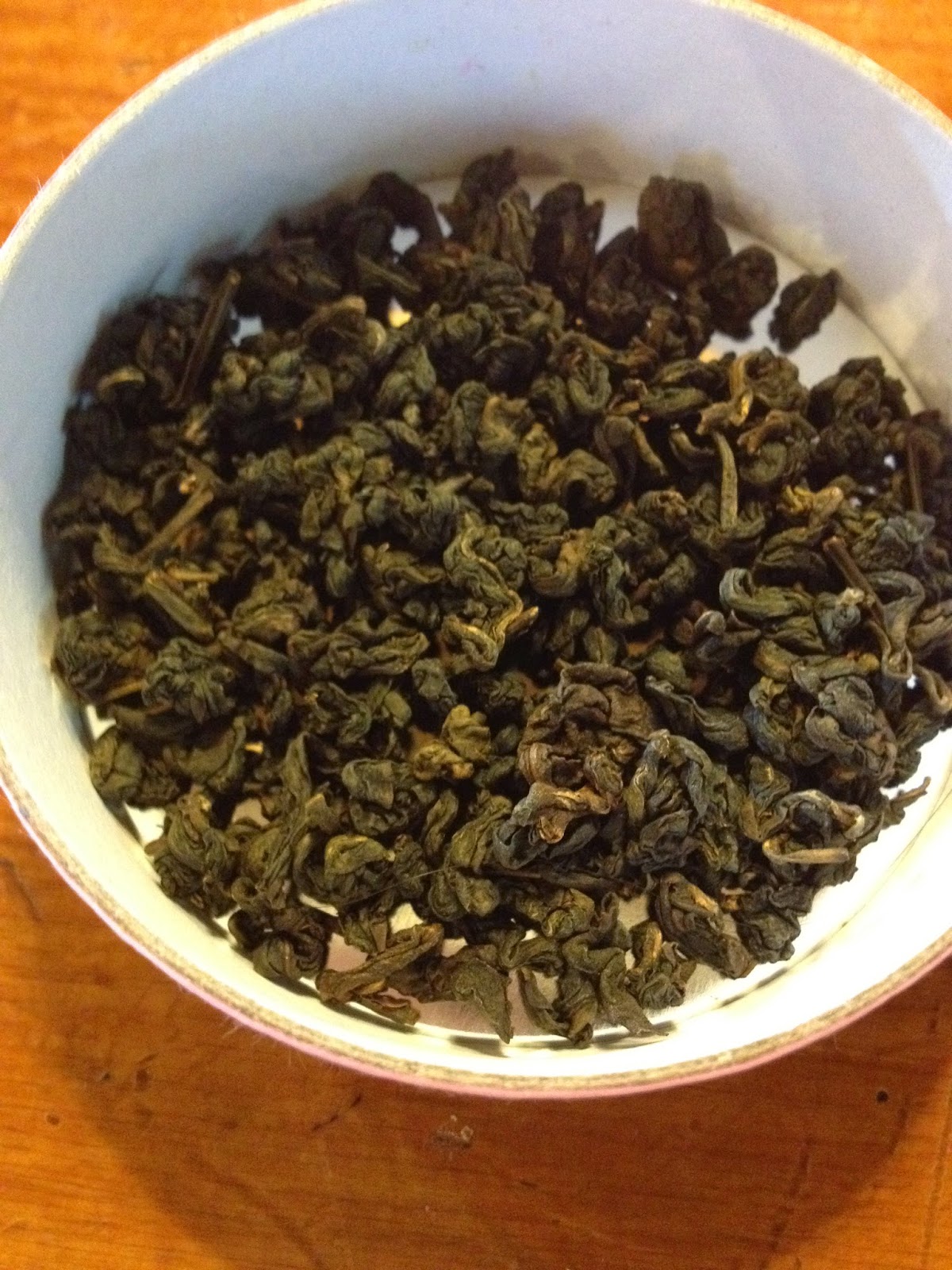
I brought back a hearty 2009 Muzha Tieguanyin to add to this season's tea selection. A traditional Muzha Tieguanyin is the tea I go for in cooler weather and especially during the winter. The tea broth is rich and savory, and it brings a lot of warmth. I also really enjoy all that a good Tieguanyin has to offer:  Hui Gan (salivating) and Hou Yun (a wonderful sensation at the back-of-the throat area while the broth passes through it).


When I first tasted this 2009 Tieguanyin, I thought it was on the heavy side. However, as the tea opened up, it kept tasting better and better throughout multiple infusions. The stimulation of anticipatory salivation, the feeling of the tea broth, and the pleasantly warm sensations throughout my body just keep going on and on.

I was very happy I got to taste Tieguanyin with Mr. and Mrs. Zhang on my recent Taiwan trip. It is always a delight to taste tea with them. They let me taste two of the Tieguanyins that were made in November 2014. The tea tasted good, but some of the good features that a high quality Tieguanyin have were not present. A traditional Tieguanyin goes through a lot of rolling/bruising and multiple slow roasting processes. It takes time for the tea to integrate and open. This is different from letting a new bag of tea sit for a couple of weeks before it fully opens. You have probably already noticed by now that Floating Leaves Tea carries current seasonal teas like the Spring and Winter Baozhong, High Mountain Oolongs, Dong Ding, etc.... However, the traditional Muzha Tieguanyin that I chose for the shop is not the current season's production because a good one can take a little longer (one or more seasons) to transform into something really special. Lighter and greener Tieguanyin teas, such as what's popular in mainland China now, do not generally benefit from age or more processing, so mainland Tieguanyin is often enjoyed while it's fresh.


The date for tasting the new season's Oolong teas is Feb. 21st from 11am to 1pm. You can request the tea you want to try and there are no reservations needed.  Come early as it may get busy and it will be first come, first served. If I am organized enough, I will try to have some treats for Chinese New Year on that day, too!

Saturday, May 17, 2014

Muzha Tieguanyin Farmer Talking About Tea - Part II

As Farmer Chen brewed the third tea for us, he said, "To roast a tea this heavily takes courage. I have failed with thousands of jin 斤 (a weigh measurement of 600 grams) in order to learn. The temperatures goes up to 130 celcius. Normally people stop at 120." He said he wanted his tea to climb mountains, go to the peak, come back down to the valley, and then go back to the top. He said that when his tea arrives on the top of the mountain, it says thank you, and the mountain peak would talk back and say thank you as well. How beautiful! I savored the tea while busily translating.

He then talked about the Chinese character for "tea 茶." He said the tea character has three parts: grass, human, and tree (tea plant). The human does the work for the grass and the tea plant. While I was translating, everything made sense. Now I can't quite remember what he really meant! Well, I will ask him when I see him next time.


We drank more tea and his wife came out with some tea plums and crackers for us.

The farmer continued,"the third time when he shakes the green, he knows what the tea will be." He used Do-Re-Mi as an analogy. He said a good tea keeps going up from one infusion to the next. He said, "when making tea, I pull it in, let it go a little, pull in, let it go a little. I don't let my tea shine right away. My tea is more for the long haul. It keeps turning, and changing. I want my tea to be an endurance tea. I control when it peaks and how long it lasts by how I make it."

His smile and pride shone through his face. I felt so honored to share his knowledge with this incredible group of people, so open and so eager to take everything in. With my son's laughter in the background and delicious tea in front of me, I have to say, I am very lucky, and it was indeed a very good day!


*Thank you, Stephanie Wilson, for sharing the notes!
*photos provided by Matthew Kraus.

Thursday, May 01, 2014

Muzha Tieguanyin Farmer Talking About Tea - Part I

I have been planning my next Taiwan Tea Tour (it's tentatively scheduled to be around Christmas/New Year's time - more information coming soon), and remembered that I didn't finish writing about 2013's May Tea Tour. It's almost the anniversary!

I have been wanting to write about what the Muzha Farmer taught us during our previous trip. One of the tour members, Stephanie Wilson, is a great note taker and she has been very generous to share her notes with me. When I went through her notes just now, it immediately brought me back to when we drank tea at the Muzha tea house.

photo provided by Matthew Kraus

I have known Farmer Zhang for about 4 years now. He is one of my favorite tea people in the whole world. I love his smile and his dedication to good tea. The more I know about him, the more I respect him as a farmer and as a tea person. He doesn't simply grow tea and make tea. Tea is an art and love for him. And he "designs" his tea and hopes that tea drinkers can understand what he tries to present.

After we sat down to have tea with Farmer Zhang, Stephanie noticed and wrote in her note," Great smile, dirt under his nails....being from a farming family myself, I love that." I love that, too! The following picture is Farmer Zhang, and I hope you can see what we saw in him that day.

photo provided by Stephanie Wilson


The first tea he served us was one that he had just finished roasting about an hour before we had arrived. Through this tea, he guided us to taste the base and broth. He told us that the tea was not quite ready and the energy wouldn't be showing up fully yet, but he wanted us to taste something that was he had just finished working on. He then asked me where this group "was" in their tea abilities. I told him some of them could taste tea very well.

He proceeded to brew the next tea. He said, "Tieguanyin is a slow tea - you cannot hurry it. It takes about a month to open. If hurried, it becomes bitter. A good Tieguanyin liquor is yellow with a red base." Then he continued, "When I am checking a tea, if I can make a pot for 9 to 10 times, then the tea can withstand 50 years. Good tea is hard to find, just like true love. One must know the tea by going really far to see if it's good. Whether a tea can last through the years is dependent upon the tea maker."

photo provided by Matthew Kraus


While I am writing this, I am sipping his 2012 Tieguanyin. Part of me is here and part of me is in Taiwan. I think I will stop now and just savor his tea for a while. I will continue with the notes in my next post.

Meanwhile, if you want to read more about our trip, please check out Stephanie's blog: http://stephcupoftea.blogspot.com/search/label/Taiwan%20Tea%20Tour She has wonderful writings about the trip and the tea!

Sunday, May 20, 2012

Muzha, May 17th, 2012

I went to Muzha to visit Farmer Zhan today. He and his wife were busy working on remodeling their teahouse and I was grateful they took the time to drink some tea with me.


During the Japanese occupation era, it is believed two Zhan brothers brought the Tieguanyin tea plants from Anxi China and planted them in the Muzha area of Taiwan. Farmer Zhan said he is the fourth generation of this lineage. When asked when he started learning to make tea, he replied ,"At age 6, my father would give me some simple tasks. By age 9, I followed my father around when he was making tea. I remember my father would wake me up and ask me to start a fire for roasting tea. I would fall asleep from time to time when I fan the fire and my father would wake me up. Sometimes I would cry because I was very sleepy. One time my father told me I have to do my job, regardless of whether I cried or smiled. Since then, I have never cried."

Making a traditional style Tieguanyin takes days. Tieguanyin tea has a particular process that other oolongs don't have. Tieguanyin tea has to be rolled many times. For high mountain tea, this rolling happens close to be the end of the processing. The purpose is to squeeze some of the juice out to the surface and to shape the tea. For Tieguanyin, the rolling happens in the middle of the process and helps bring out the rich flavor and body. This process alone can take 2 1/2 days. Farmer Zhan told me it takes him four days to finish a batch of tea. 

Farmer Zhan believes in tradition. He said Tieguanyin tea is very special and we are blessed with the tea processing skills from our ancestors. He said he has to do his best to keep this special gift. I love to listen to him talk. His face brightened up with one of the most beautiful smiles I have ever seen.


Farmer Zhan is also very proud of his organic farming. He said lots of farmers use chemicals to kill the grass on the fields to save time and money. He uses a wonderful natural fertilizer for his precious tea plants that enhance flavors and act as a natural pesticide.


I asked him what flavor and body I should be looking for when I drink a Tieguanyin. He said, "satisfying." I laughed and totally knew what he was talking about. I have met a lot of farmers and tea drinkers in Taiwan and notice that none of them describe tea flavors in details. He continued, "Tieguanyin is a long lasting tea. One can make a lot of infusions. When you drink a good Tieguanyin, the broth is rich and you should feel a warm energy reaching to the area below your belly button."


I drank some teas with him and chose one that I feel has good tea energy. The tea broth is rich and soft. I think some of you will really like this tea, just like I do.

Thursday, June 02, 2011

Taiwan Tea Trip: Muzha Part III

The Chinese say that to make a good tea takes Time/Weather 天時, Location/Soil 地利, and Human/Skills 人和. After several years of watching how an Oolong is made, I have to say I have a lot of respect for those dedicated tea farmers.

Traditional Tieguanyin is rich in its body and flavor. This tea takes more oxidation 發酵, stirring 攪拌, and roasting 烘焙 when compared to Baozhong and High Mountain Oolongs. In fact, it takes more work than just about any other oolong tea. On our most recent tea tour, we were lucky to see part of the oxidation and stirring processes.


We went inside a small room where there was a metal tube, a tumbling machine, and a tea rolling machine. We also saw small balls of tea on the floor. Farmer Zhang opened one ball and loosened up the tea leaves a bit on a bamboo tray, then he tossed the leaves in a tube that heated up the leaves (I forgot to ask what the temperature in the tube was). Once in a while, he would reach in and feel the tea. I remembered one time I was on Dong Ding mountain and a tea maker offered to let me reach in the tube and feel the leaves. I turned down that opportunity because I noticed that temperature read 300C and I could hear a hissing sound from the leaves!


After he poured the leaves out of the tube, he rolled them up and would then pick up another ball of tea from the ground and repeat the process. He told us that he had to do this about 50 times!


Tieguanyin is known for its roasting. Farmer Zhang told us that he would do one roasting and let the tea rest for about two weeks before doing further roastings. He said a lot of customers go to him for Tieguanyin that was done a year or two ago. After that amount of time, the tea's fire will mellow, which makes the tea rounder and smoother. He said Baozhong and high mountain oolongs are designed to be drunk when fresh. That kind of tea is bright and the energy focuses on the head and mouth area, while Tieguanyin's focus is on the throat area and its energy travels down through one's whole body.


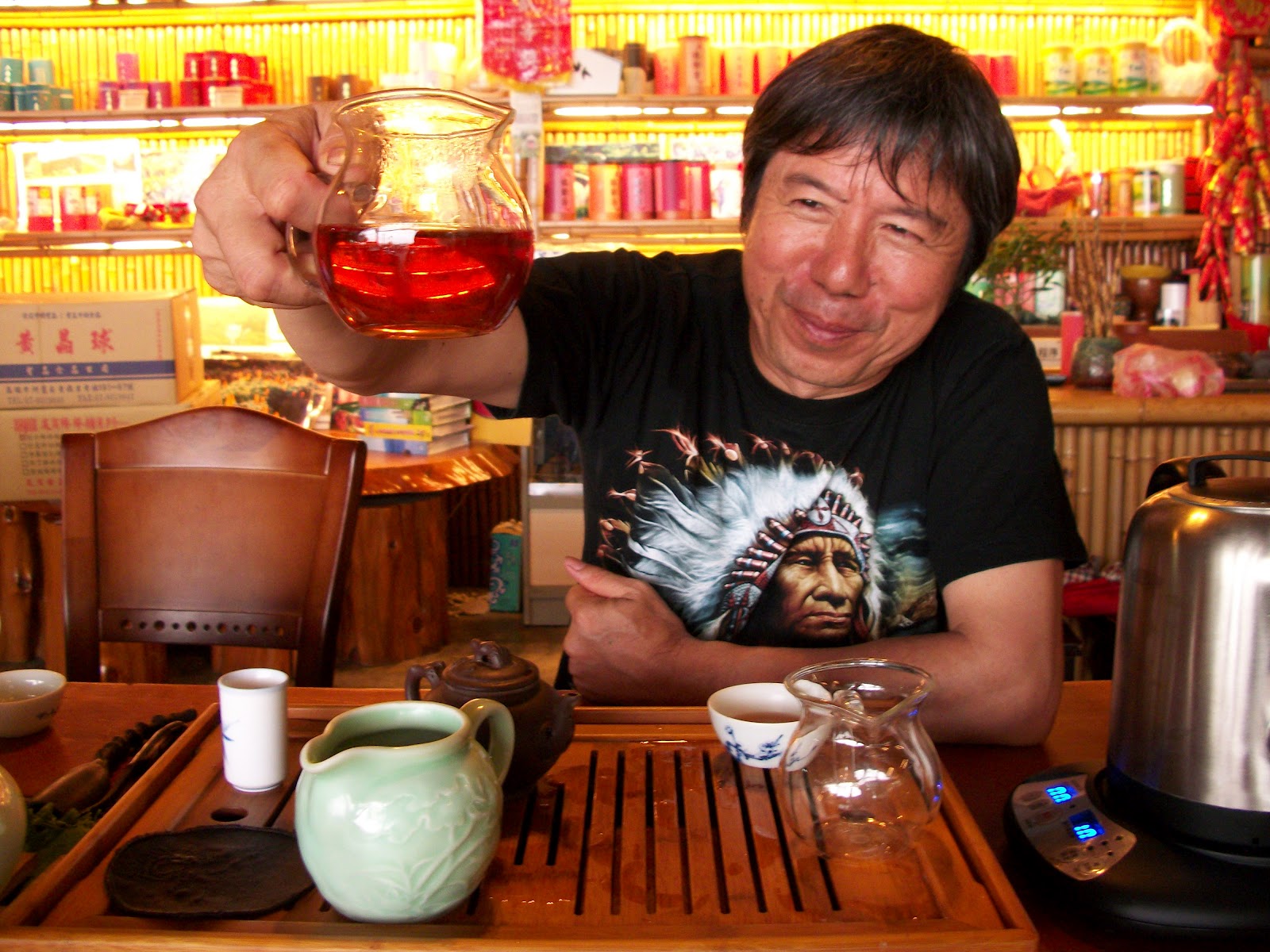
And here is the delicious cup of tea the farmer is looking for.......